The Mountain That Fell into My Fondue
Jacquère, Apremont and a rather extraordinary geological accident in the French Alps.
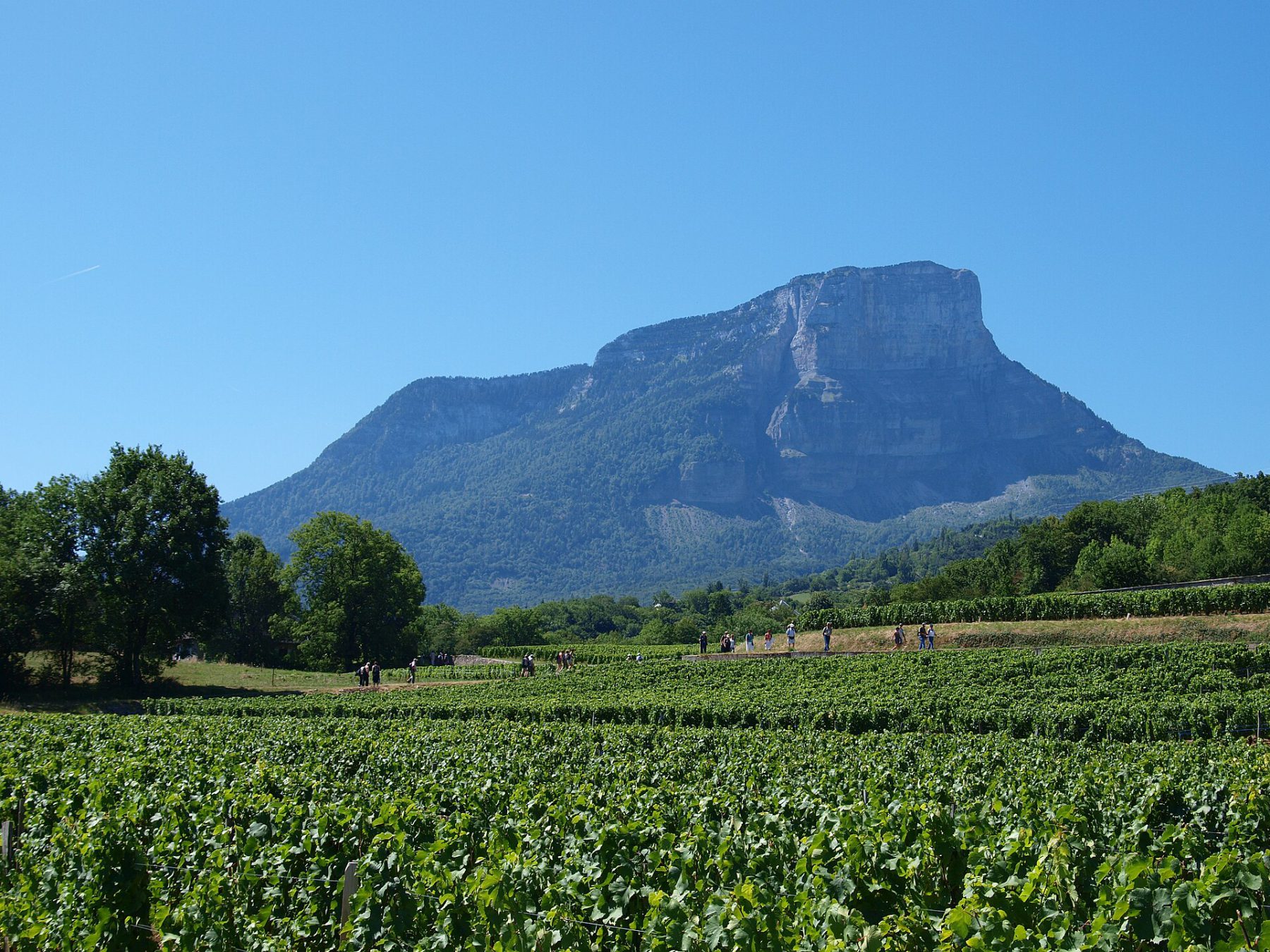
Mont Granier above the vineyards of Apremont. Photo: Dabigben73, CC BY-SA 3.0, via Wikimedia Commons.
The first time someone offered me Jacquère with a fondue, I wondered whether I could politely ask for Burgundy instead.
I was skiing in Courchevel, and my hosts had put Apremont and Abymes on the table. Until I began studying wine seriously, I had quietly assumed that the world’s greatest grapes were also its most famous ones. Chardonnay, Riesling and Sauvignon Blanc were varieties I knew and trusted. Jacquère felt like a curiosity from an obscure corner of France.
I circled it uncertainly, asking my hosts, very politely, if they maybe had something from Burgundy.
There was almost a Teutonic shaking of heads.
Apparently not.
So I accepted a glass of Jacquère, with the sort of resignation usually reserved for an airline seat beside the toilets.
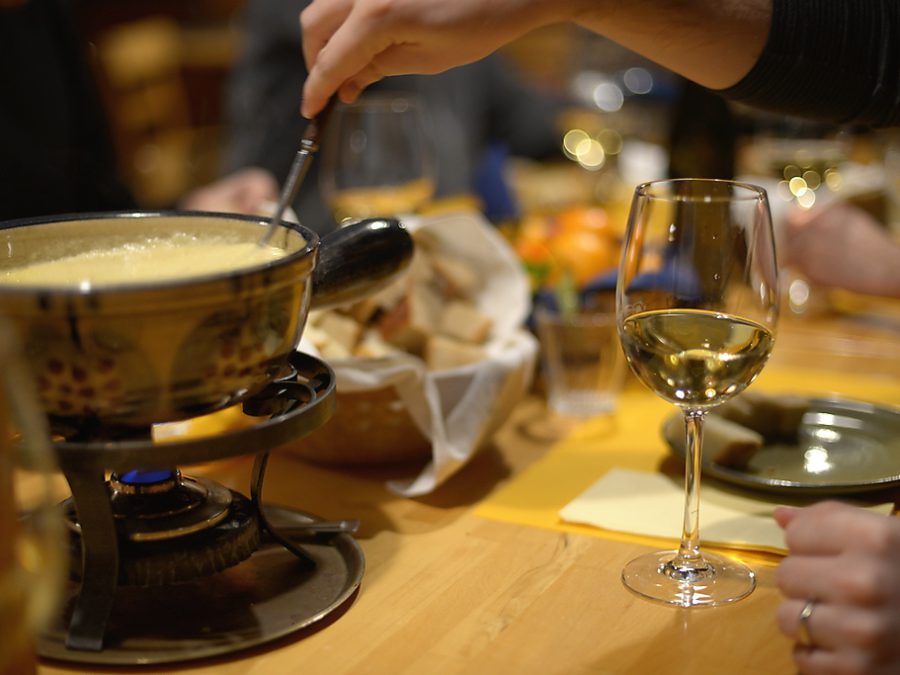
And then came the fondue.
An enormous pot of melted cheese, chunks of bread and the sort of enthusiasm that makes one forget there are other food groups.
The wine was pale, almost translucent, with delicate aromas of white flowers, green apple, pear skin and lemon zest. Light-bodied and wonderfully fresh, its acidity cut through the richness of the cheese with astonishing precision.
I surprised myself by agreeing there was probably no better wine for the occasion.
That distrust and preconception lasted exactly one fondue dinner.
And from that moment I wanted to know more about the grape and the landscape that produced it.
A grape that doesn’t announce itself
Jacquère is one of the principal white grapes of Savoie, the mountainous region of eastern France where vineyards occupy slopes and valleys beneath the Alps.
It is hardly a household name outside the region.
Which is a pity.
Jacquère generally produces dry, pale, light-bodied wines with lively acidity and relatively delicate aromas. Green apple, citrus, pear and white flowers are common descriptions. The wines are often modest in alcohol, although that depends on the producer and vintage.
There is nothing particularly flamboyant about it.
It doesn’t have the aromatic exuberance of Gewürztraminer or the immediate familiarity of Sauvignon Blanc. It is not trying to be Chardonnay.
It is Jacquère.
And it does what it does rather well.
The labels, however, require a little explanation.
Jacquère is the grape. Apremont and Abymes are places.
More precisely, Apremont and Abymes are named geographical denominations within the Vin de Savoie appellation. Both are associated with Jacquère, and both lie beneath Mont Granier, a mountain with a rather tragic history.
The vineyards occupy parts of a landscape created by one of the most dramatic landslides in European history.
Which brings us to the mountain.
A geological catastrophe
On the night of 24–25 November 1248, part of Mont Granier collapsed.
Not a few rocks tumbling down the hillside.
The mountain gave way in a catastrophic landslide involving enormous quantities of marl and limestone. Rock, mud and debris swept across the valley, burying settlements and transforming the landscape.
The scale was extraordinary.
Some estimates put the total volume of the landslide and the material it set in motion at around 500 million cubic metres. The debris spread across a vast area, reaching roughly eight kilometres from the mountain. These are estimates of a complex collapse and its aftermath, not precise measurements of a single falling cliff.
Eight kilometres.
An entire landscape rearranged itself.
Medieval settlements were destroyed. Historical accounts give wildly varying death tolls, with some chroniclers claiming several thousand victims. Modern estimates are generally lower, sometimes around a thousand, but the true number remains uncertain.
The villages disappeared beneath the debris.
And the mountain was left with an enormous scar.
Eight centuries later, the scar is still there.
So are the vineyards.
From rubble to vineyards
During my wine studies, I became fascinated by the story of Mont Granier.
The buried settlements, the shattered mountain and the extraordinary patchwork of ground left behind seemed impossible to ignore.
I wanted to stand where those vines grew.
When I eventually visited Savoie, the vineyards were dormant beneath a pale winter sky. Smoke rose from chimneys. The villages seemed impossibly calm, their stone buildings settled into the landscape as though they had always been there and always would be.
The first thing I noticed was not the vineyards.
It was the mountain.
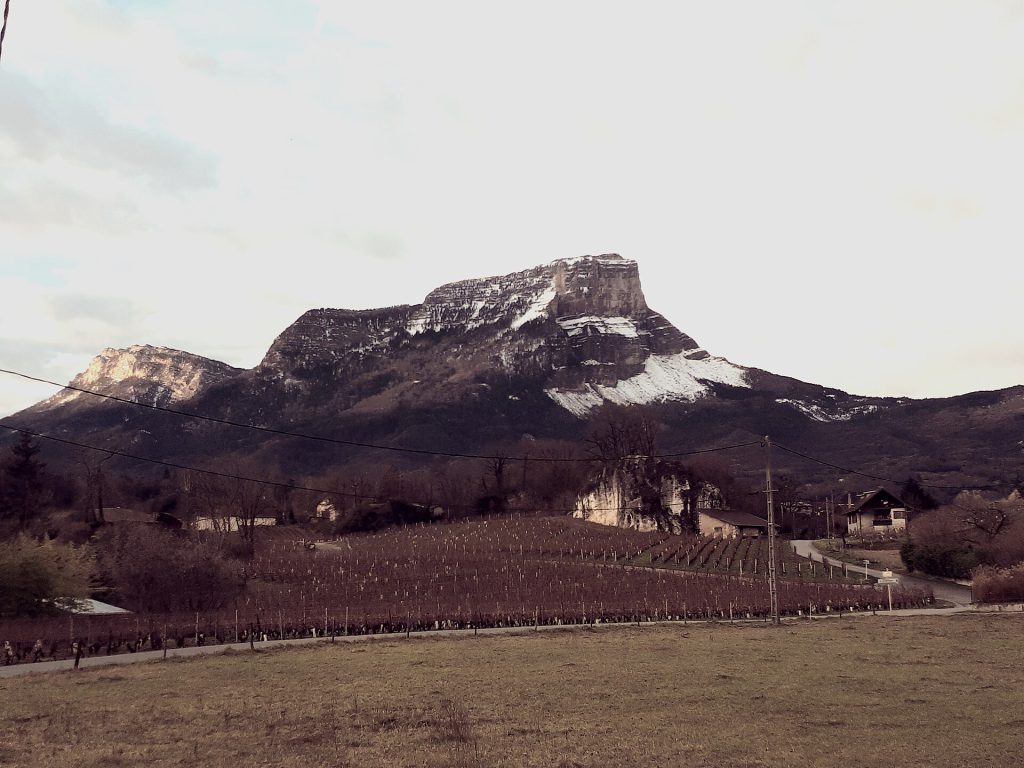
Mont Granier dominates the valley in a way that makes perspective difficult. You think you are looking at a distant cliff until you realise it occupies almost the entire horizon.
Even before you know the story, it draws the eye.
The second thing I noticed was how peaceful everything felt.
Nothing hinted at what lay beneath.
Nothing in the scene suggested disaster.
And yet the vineyards of Apremont and Abymes owe part of their distinctive physical landscape to that catastrophe.
The rock that collapsed from Mont Granier included limestone formed in a marine environment during the Cretaceous period, long before there were vines growing in Savoie.
When the mountain fell, it left behind great quantities of broken limestone and other displaced material. Over the centuries, weathering and soil development altered the debris, while farming shaped the vineyards that occupy parts of it today.
Some soils contain angular limestone fragments mixed with finer material. Their structure, depth and drainage vary from site to site.
This matters to vines.
A soil’s physical properties help determine how water moves through it, how much remains available to roots and how the vine responds during the growing season.
But there is something I should clear up before anyone starts licking rocks.
Can you taste the limestone?
Wine descriptions frequently use words such as mineral, chalky, flinty and stony.
Apremont is often described as mineral.
And I understand why.
There can be a delicacy and freshness to Jacquère that brings to mind cold spring water, wet stone and mountain air.
But that doesn’t mean the limestone beneath the vines has somehow travelled through their roots and arrived in the glass tasting of rock.
The connection between geology and flavour is more complicated.
Soil influences the vine’s growing environment. Water availability, drainage, temperature, exposure and other factors can affect vine growth and grape ripening. The grape variety contributes its own characteristics, and the winemaker has an enormous influence on the finished wine.
In other words, the rock matters.
But not because we’re drinking it.
I find that far more interesting than the idea that every wine grown on limestone must taste of limestone.
And it makes the landscape beneath Mont Granier rather special.
Here is a place where you can look at the mountain, look at the debris beneath the vines and understand that a single geological event helped shape the ground on which today’s vineyards grow.
The story is written across the valley.
You don’t need to find it in the glass to appreciate it.
And back to the fondue
There is, of course, a much simpler reason to become fond of Jacquère.
It is absolutely delicious with cheese.
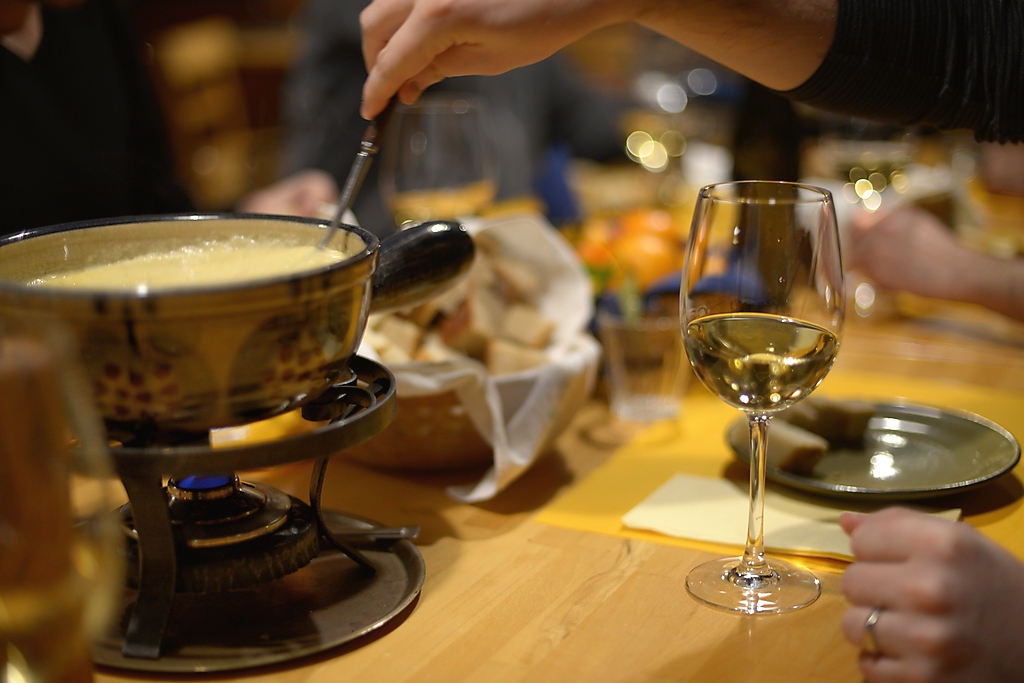
A traditional Savoyard fondue is rich, warm and wonderfully filling. The cheese coats the palate, the bread disappears at an alarming rate and someone inevitably insists that everybody needs another helping.
A young, dry Apremont offers a refreshing contrast.
Its acidity brings liveliness to the pairing, while its relatively light body means the wine doesn’t overwhelm the food.
It doesn’t perform some magical digestive trick.
It simply works.
And rather beautifully.
Later, sitting in a chalet restaurant in Savoie and working my way through local wines, I found myself looking out across the landscape that had created them.
Snow drifted gently through the darkness.
Inside, glasses of Jacquère caught the light.
White flowers. Green apple. Pear skin. Lemon zest.
Alpine freshness—cold spring water, wet stone and mountain air.
Its acidity tasted of the cold outside the window.
Mont Granier dominated the view through the restaurant’s windows. The great scar in the cliff face was still there, a reminder of the catastrophe that had transformed the valley almost eight centuries earlier.
The most remarkable thing about this landscape was not that the mountain had fallen.
It was that life had continued.
The villages that replaced the buried ones are quiet and prosperous. The vineyards produce wine that people drink with pleasure and without solemnity.
The fondue is excellent.
The wine is cold and precise and entirely itself.
And I was very glad nobody had produced that Burgundy.
At the table: the wine and a Fondue Savoyarde recipe →
Sources and further reading
- ISTerre, Université Grenoble Alpes: Gravity instability: the Granier disasters
- Hantz et al.: study of large rockfalls in the French Alps (PDF), which includes the 1248 Granier event
- Reconstructing patterns of vegetation recovery and landscape evolution after a catastrophic landslide (Mont Granier, French Alps, 1248 CE), Anthropocene, 2022
- La Houille Blanche (1991): paper on the mechanism and extent of the 1248 Granier rockslide avalanche
- INAO / French Ministry of Agriculture: Vin de Savoie specification (cahier des charges), 2023
- Decanter: Forgotten France: the wines born on the fallen mountain of Apremont
- Domaine Giachino: Apremont (producer’s page, in French)

Linda Hamilton-Evans writes about wine and landscape from the South of France. She’s working on Earth to Glass, and she also chooses wine for a small number of private clients. About curation →
Wine & travel stories, by email
New stories and field notes, roughly once a month.